Should You Put Assets In Your Kids' Names? Why Wealthy Canadian Families Never Do
The Wealthiest Families In Canada Almost Never Give Their Kids Anything
Not the company. Not the property. Not the investments. Nothing goes into the kids' names, and sometimes it stays that way for decades.
When people hear that, they assume it's about control. Rich parents holding the purse strings, keeping the kids in line.
It isn't. We've sat across the table from these families for 15 years, and the reason is much simpler, and much more useful to you than it first sounds.
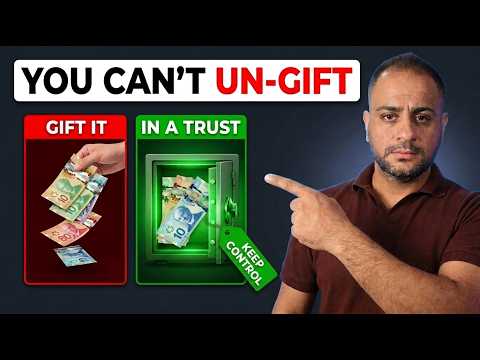
A gift is the one financial move you can never take back.
The Question Every Parent Gets Wrong
Picture where a typical business owner actually sits. They're 58. They built something over 30 years. They have 2 kids. One has their head straight on. The other one, they're not so sure yet.
They don't know who either kid will marry. They don't know who those kids will become in 10 years. Nobody does. People change, and the uncomfortable truth is that at every age we believe the people around us are finished changing, and we're wrong every single time.
But putting an asset in a kid's name forces you to decide today. About people who are still becoming who they'll be.
And if you guess wrong, there's no undo. Not for you, not for your lawyer, not for anyone.
That's not just a money problem. Guessing wrong is how families stop speaking.
What Actually Happens When An Asset Lands In Your Kid's Name
Three doors lock behind you the moment you sign, and most parents don't hear any of them.
1. Their problems become the asset's problems.
Your son is 28, married, responsible. You give him shares because he works in the business and it feels right. Four years later the marriage ends. Those shares didn't stay separate, because he believed the marriage was solid, so they went into the joint accounts and the house. Now a piece of what you spent 30 years building is part of a conversation in a lawyer's office.
2. Your other kids are watching.
One kid got shares. One got nothing yet. Nobody says anything, but a quiet scoreboard starts running, and it doesn't stop. I've watched that scoreboard come out loud 20 years later, in an estate dispute, between two people who used to spend Christmas together.
3. There is no undo.
This is the one that matters most. You made a permanent decision about a person who was still changing, using the least information you'll ever have about them.
What Wealthy Families Do Instead: The Family Trust
Before your eyes glaze over at the word trust, it's simpler than anyone makes it sound.
Picture a safe.
You hold the only key. Inside goes the valuable stuff: your company, your investments. And taped to the inside of the door is a list of your family's names. Your kids. Even grandkids who don't exist yet.
Next to every name, the amount is blank.
You fill those amounts in later. Whenever you want. However you want. Years from now, when you can finally see how your kids actually turned out.
That's a family trust. That's the whole idea.
Do you lose control of your company?
No. You still run it. Every decision, same as yesterday. The trust holds it. You control the trust. This is the single most common fear I hear, and it's based on a misunderstanding of what a trust is.
Isn't that what a will is for?
A will speaks once, after you're gone. A trust works while you're alive, and that's exactly where the power is. Your company can pay its profits into the trust year after year, and you decide which family member that money goes to. This year one kid's tuition. Next year a different kid's down payment. The answer changes as your family changes.
One important caution: there are strict rules about who can receive that income. The government closed the old income splitting door years ago. Anyone telling you a family trust means your teenager pays your tax bill is working from outdated information.
The Bill Most Canadian Families Meet Exactly Once
Canada has no estate tax. You've probably heard that. Here's what nobody adds.
The day you die, the government pretends you sold everything you own that morning. Your company. Your investments. All of it, sold on paper at full value.
And your family pays tax on all of the growth. Immediately. While they're grieving.
This is the part that turns a lifetime of building into a fire sale. Grieving families sell assets in a hurry because the bill doesn't wait for them to feel better.
The Timing Decision Worth $1.3 Million
Here'e the move, in plain language. When your company goes into the trust, you lock in today's value as yours. Whatever the business is worth today, that number stays yours, and it stops growing in your name from that day forward. Everything the business becomes after that day belongs to your family, through the trust.
Today's value stays yours. Tomorrow's growth belongs to your family.
Because that growth was never yours, it's never taxed as yours. Not while you're alive. Not the morning you die.
Two families make this concrete. Both built companies worth about $1 million. Both companies eventually grew to $6 million.
- The first family never planned. The whole $6 million was sitting in dad's name at the end. The bill that landed on his kids was roughly $1.6 million, due immediately.
- The second family locked in the value early, back at $1 million. The next $5 million grew inside the trust. Their bill was about $270,000.
Same size company. Same country. Same tax rules. But, a $1.3 million difference, because one family moved while their number was still small.
To be straight with you: the growth inside the trust does get taxed one day, when the family eventually sells. On their timeline, not a funeral's. The difference is control over when, not the disappearance of tax.
Why timing decides everything.
The best day to do this is when your company is worth the least, Early, while you're still building. Even in a down year, when your value dips, this move is on sale. It's a strange way to think about a slow year, but it's true.
Wait until you're worth $6 million and there's nothing left to protect. The growth already happened, in your name. That's the part nobody can undo, and it's the conversation I hate having most.
When Do Your Kids Actually Get It?
One day, the assets do come out of the trust and land in your kids' names. That was always the plan.
The rule was never "never." The rule is "not yet."
There's even a deadline. Canadian trusts get 21 years to pass assets out to the family, and done right, that transfer happens with no tax.
But here's the difference that matters. Picture making that call years from now, at your own kitchen table, family around it. You'll know which kid stepped up. You'll know who's in a solid marriage. You'll know whether the business sold. You'll know your grandkids' names.
And with all of that in front of you, you take out the list and you'll fill in the blanks. You won't be guessing anymore. You'll be deciding.
The parent who gifts answers the hardest questions of their life on the day they know the least. A trust lets you answer it on the day you know the most.
Who Should Actually Do This (And Who Shouldn't)
There are only 2 reasons to set up a family trust.
Reason 1: What you've built.
A business, a real estate portfolio, an investment company. If it has real value, or you can feel it heading there, that's the moment. Set the trust up early, lock in today's number, and everything from there grows on your family's side. You don't need a buyer. You don't even need a plan to sell.
Reason 2: Your family.
If you're in your 50s or 60s, you've built real value, and the words "I don't know which kid," or "I'm worried about a divorce," have ever crossed your mind, this structure exists for exactly that.
Who should skip it?
If you don't have a business, real estate, or real assets to direct, you don't need a family trust. It would be a document and an annual bill. Anyone selling you one anyways is billing you, not helping you.
We say that in a video about family trusts, and we mean it. This isn't a loophole the wealthy found. Every piece of it sits inside the Income Tax Act. It's a structure the rules were built to allow. Most families just never hear about it in time.
The Next Step
If you want to figure out which lane your family is in before you ever pick up a phone, we put together the Family Trust Decision Guide. It walks through both lanes, the timing test, what a trust does and doesn't do, and exactly what to bring to a real conversation so you don't waste it. It's free.
And if your family is in one of those 2 lanes, that's a conversation.
👉 The Family Trust Decision Guide: https://www.theadvisorstable.com/resources/the-family-trust-decision-guide
👉 Watch Full Video Here: https://youtu.be/psBz9kONiP4?si=GVtmAQps9zxN9jL6
The Family Trust Decision Guide
The Advisors TableThe Family Trust Decision Guide
Use this guide to determine whether a family trust fits your situations and learn when it can help protect wealth, reduce tax, and preserve flexibility.
Senior Tax Manager · Tax Manager
Two ways in: the groundwork under our advisory files, or a senior seat with a defined path to Manager.